Shoplifters (2018) - Movies Like Parasite | Filmiway

Why This Class War Film Matters
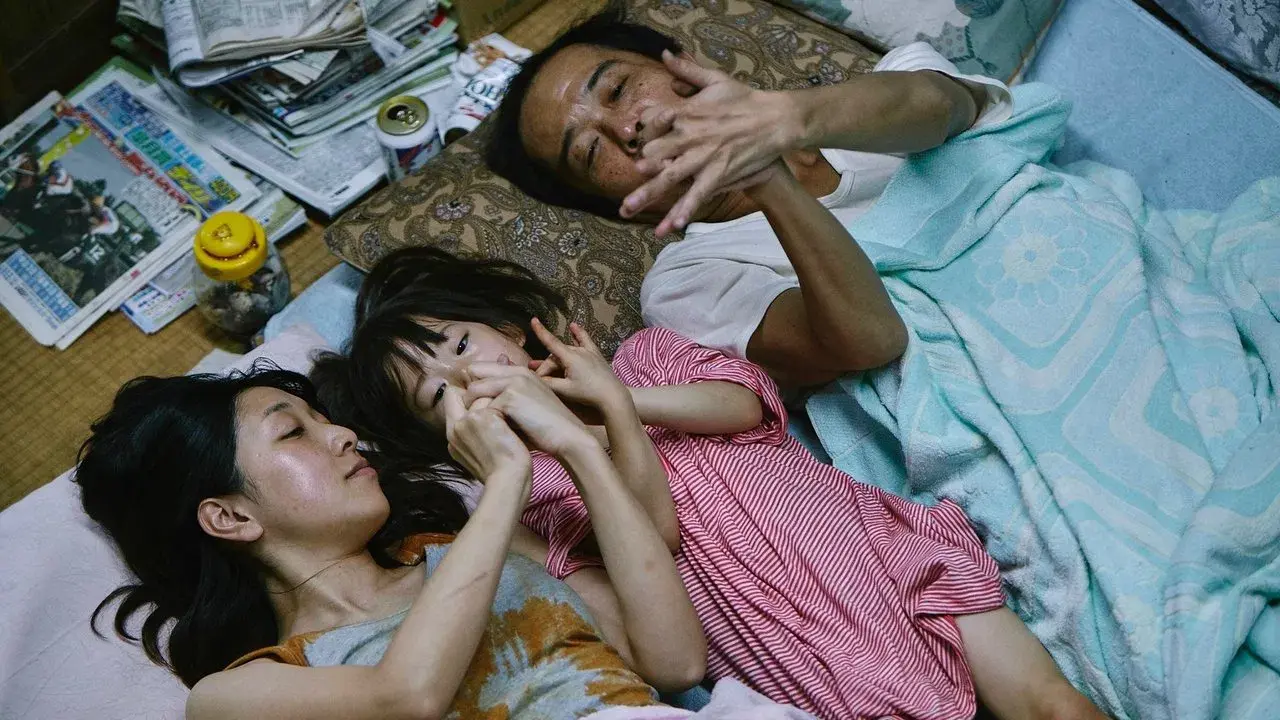
Shoplifters asks: what makes a family? The marginalized must steal to survive while society abandons them, criminalizing poverty while ignoring neglect.
Shoplifters
The Experience
On the margins of Tokyo, the Shibata family survives through petty shoplifting. When they take in an abused girl named Yuri, their fragile happiness grows—until authorities discover their secret. Kore-eda's Palme d'Or winner is a devastating portrait of Japan's invisible underclass.
Cast & Crew
Director: Hirokazu Kore-eda
Starring: Lily Franky, Sakura Ando, Mayu Matsuoka
Production Details
Budget: $8.2 million
Box Office: $68.2 million
Content Advisory
Contains: Mature Content, Nudity/Sexual Content
📊INTENSITY GRAPHIntensity GraphShows plot intensity
throughout the movie. Higher peaks
indicate more intense moments.
throughout the movie. Higher peaks
indicate more intense moments.
🧬CINEMATIC DNAGenre DNA BreakdownVisual representation of the movie's
genre composition. Larger segments
indicate dominant genre elements.
genre composition. Larger segments
indicate dominant genre elements.
Genre DNA Distribution
- Drama: 70%
- Family: 25%
- Crime: 5%
Movie Intensity Arc
- Minute 15: Family Life (20/100 Intensity)
- Minute 40: Yuri Arrives (35/100 Intensity)
- Minute 70: Beach Trip (50/100 Intensity)
- Minute 95: Discovery (75/100 Intensity)
- Minute 115: Separation (85/100 Intensity)
Community Reviews
Frequently Asked Questions About ShopliftersFAQ About Shoplifters
Common questions about Shoplifters and its exploration of class warfare and social inequality.
What is the meaning of the title vs. the family?
The title suggests a film about criminals, but the story reveals a tender, loving family unit. The irony is that this 'fake' family, bonded by crime and choice, shows more genuine love and care than the 'real' biological families that abused and abandoned these characters.
Why does the grandmother keep the family together?
Grandma Hatsue is the financial anchor (via her pension) and the emotional center. Her home provides a sanctuary for society's castaways. Her character challenges the concept of blood relation, suggesting that shared survival and kindness create stronger bonds than genetics.
Is the ending a tragedy or a return to order?
It is a tragedy disguised as order. The law separates the family and returns the children to their 'rightful' but abusive or neglectful environments. The film critiques a society that values legal definitions of family over actual well-being, showing how the 'system' destroys the only safety these characters had.
What does the film say about poverty in Japan?
It exposes the 'invisible' poverty in a wealthy nation. The Shibatas work hard but can't survive without stealing. It critiques the social safety net that lets children and the elderly slip through the cracks, forcing them to form alternative, illegal communities just to survive.
Movie data and posters powered by

This product uses the TMDB API but is not endorsed or certified by TMDB.
Curated by Filmiway Editorial Team
Expert analysis of class warfare cinema